California DUI Deaths, Injuries, Arrests and Repeats Down

THIS IS A PRESS RELEASE FROM THE CALIFORNIA DMV.

March 31, 1997

DUI Deaths, Injuries, Arrests and Repeats Continue to Drop


Deaths from alcohol related accidents fell again in 1995, as did
injuries, DUI arrests and repeat offenses, according to an annual report
to the legislature issued by the California Department of Motor
Vehicles.

"The report reflects an unprecedented change in public behavior that
saves hundreds of lives yearly," said Department of Motor Vehicles
Director Sally Reed. "This is the sixth straight year the numbers have
declined," she added.

She said the change was brought about by public pressure, tough new
laws, strong law enforcement efforts and public education campaigns.
Alcohol related deaths, which peaked at 2,754 in 1987, fell to less than
half that at 1,343 in 1995. Reed said though she was pleased with the
improvement, she realizes that each death is a cause for concern.

The survey shows about 90 percent of DUI offenders are male, the
average age is 33 years old, and the Blood Alcohol Concentration (BAC)
averages almost .17 — more than twice the legal limit of .08.

The report shows that DUI offenders were less likely to be repeaters
than in previous years. In 1989, repeat offenders accounted for 37
percent of DUI convictions. That figure dropped to 31 percent in 1994,
the last year for which data is complete. Applying the percentages to raw
numbers makes the drop more dramatic from about 80,500 repeaters in 1989
to 45,000 in 1994.

In evaluating which sanctions prevent repetition of DUI offenses, the
report concludes that those given license restrictions combined with a
treatment program do at least 12 percent better than with any other
alternative.

The data also shows that jail was the least effective penalty for
first offenders. First time offenders sentenced to jail had 20 percent
more subsequent DUI incidents than those sentenced to other DUI
sanctions. Sanctions evaluated were probation, jail, various alcohol
treatment programs, license suspensions by DMV and the courts, and
mandatory use of an ignition interlock device.

Approximately 73 percent of all those arrested were convicted of a DUI
offense and another 9 percent were convicted of reckless driving
involving alcohol.

Are you in need of a California DUI Lawyer?

DUI Attorneys


DUI Laws: California DUI Countermeasures

REPORT TO THE LEGISLATURE OF THE STATE OF CALIFORNIA

SEPTEMBER 2002

EXECUTIVE SUMMARY

Motor vehicle crashes are the leading cause of death for Americans
aged 4 to 34. In the year 2000, a total of 41,821 people were killed in
traffic crashes in America, and 16,653 (or about 40%) of those fatalities
involved alcohol. After major reductions in driving-under-the-influence
(DUI) achieved during the 1980’s and early
1990’s, progress against DUI has slowed and stalled,
and the most recent (years 1999/2000) California data show the first
increase in DUI fatalities since 1987. The prevailing view of DUI in
America since the mid-1990’s has been that all of the
easy targets of opportunity had been identified and remediated, and that
additional reductions in DUI would only be gained incrementally, and in
small measure. The slowdown of progress against DUI in the late
1990’s, along with the recent negative reversal in DUI
trends, seemed to validate the perception that "all
had been done that could be done." In light of this present
review (conducted pursuant to Senate Bill 776, Torlakson, 2001) of
scientific literature on effective DUI countermeasures, however, this
prevailing perception can be seen as self defeating and unduly
pessimistic. Based on the scientific evidence, there are at least four
DUI legislative programs and initiatives that have the potential of
producing major reductions in the incidence of DUI, as large or larger
than the reductions seen in the 1980’s. These
countermeasures include:

  1. Pharmaceutical Treatment for Convicted DUI Offenders
    Although drugs (particularly antabuse) have been used in the treatment
    of alcoholism for decades with minor success, there are new
    pharmaceutical treatments which are offering renewed hope for the
    efficacy of this approach. One promising new drug is naltrexone, which
    acts to reduce the opioid response to alcohol that causes alcoholics to
    continue drinking to excess. Since the mid-1980’s,
    studies at the University of Pennsylvania and Yale University have
    established the effectiveness of naltrexone in reducing the craving and
    consumption of alcohol. A major study of naltrexone and acamprosate drug
    treatments, alone and in conjunction with psychosocial treatment, is
    currently being conducted by the National Institute on Alcohol Abuse and
    Alcoholism (NIAAA) in 11 university research centers across the United
    States. Based on the demonstrated success of naltrexone in these
    university studies, the time is right to pilot test and scientifically
    evaluate the impact of these new pharmaceutical treatments in the real
    world applied setting of the DUI countermeasure system. The DUI system
    provides an efficient means of identifying persons in need of treatment
    for alcohol abuse via arrests for DUI, and the system structure and
    service delivery components could be used to facilitate the trial of
    pharmaceutical treatment for convicted DUI offenders, either at the
    court, probation, or drinking driver treatment program level. As in
    clinical trials, the most definitive and scientifically rigorous research
    involves random assignment to treatment conditions; in this case,
    convicted DUI offenders would be randomly assigned to existing DUI
    sanctions and treatment, or to existing sanctions and treatment plus drug
    treatment. The purpose of random assignment is to avoid bias between
    groups which could compromise the evaluation of treatment effects, so
    that the only systematic difference between treatment conditions is the
    presence or absence of the additional drug treatment. Such a randomized
    study of pharmaceutical treatment could corroborate the university
    clinical trials and dramatically improve the effectiveness of treatment
    for DUI offenders. The development of this pilot program would involve
    the input of a wide variety of professionals from the medical and
    judicial fields, as well as the cooperation of state and local agencies
    involved in DUI control.
  2. Alcoholic Beverage Control
    Research has clearly shown that alcoholic beverage control policies
    are associated with reduced consumption of alcohol and resultant
    reductions in the multiple negative consequences associated with that
    consumption, including alcohol-involved traffic crashes and fatalities.
    The federal Prohibition laws of the 1920’s
    demonstrated the positive societal benefits of reduced availability of
    alcohol, yet ultimately proved untenable because of insufficient public
    support. The majority of American adults consume alcohol, and perceive
    positive benefits from this consumption, particularly in social settings.
    Yet the vast majority (86%) of Americans also support increasing taxes on
    alcohol in order to support drunk driving countermeasure programs.
    Additional economic policies that also impact the price of alcohol
    include price controls and limits on rebates, discounts, or other
    economic inducements. Other alcoholic beverage control measures include
    marketing control policies and regulations on the manufacture,
    distribution, advertising, and sale of alcohol.
  3. Reduce crashes associated with on-premise drinking
    Research has shown that roughly half of all alcohol-related crashes
    involve drinking at an on-premise establishment, while only a quarter of
    all alcohol is consumed onpremise. These facts clearly identify
    on-premise drinking as a major target of opportunity for reducing drunk
    driving. Several DUI countermeasures address this problem, including
    designated driver programs, server intervention programs, alcoholic
    beverage control laws and server liability. Research has shown that
    server intervention programs can be effective in reducing the proportion
    of patrons who leave an establishment above illegal per se levels, and
    one study identified a reduction in alcohol crash measures associated
    with server intervention. California’s Department of
    Alcoholic Beverage Control (ABC) has an active server intervention
    program which is offered free of charge to licensed establishments on
    request. The voluntary 4-hour program has trained over 150,000 servers
    since the program was initiated in 1995. Although the current program has
    been successful, mandatory server intervention training as part of the
    ongoing ABC licensing process might have wider impact. California has not
    had an effective server liability law ever since the dram shop law was
    repealed in 1978. The Centers for Disease Control (CDC) review of server
    intervention programs and liability laws recommended that server
    liability laws are likely more effective than server intervention
    programs. In California, the gap between the current virtually
    nonexistent server liability statutes and the repealed dram shop laws
    from 1978 is sufficiently large to provide a wide
    "middle ground" for server liability
    statutes which responsibly address the overrepresentation of on-premise
    drinking among alcohol related crashes, while responding to the concerns
    of the industry (including insurance costs).
  4. Increase DUI prevention and general deterrence efforts,
    particularly those targeting youth
    If an ounce of prevention is worth a pound of cure," and
    there is evidence that this concept applies to alcohol abuse and impaired
    driving, then a shift in priorities from punishment to prevention might
    be in order for our overall societal response to alcohol-impaired
    driving. Recent research evidence that the age of onset of drinking is a
    primary predictor of adult alcohol abuse points to the need to target
    prevention efforts at youth. Research also suggests that prevention
    efforts and public information and education (PI&E) campaigns would
    benefit from a professional marketing approach similar to that used by
    commercial interests to promote alcohol consumption. One key to any
    successful PI&E campaign is to have a viable concept to
    "sell," one which will make sense to and
    be embraced by the target population. One such campaign in the area of
    DUI prevention is the designated driver program, which has survived the
    initial media blitz and become entrenched in the public consciousness as
    one practical method of avoiding alcohol-impaired driving. One of the
    more effective prevention efforts, which is often not seen as such, is
    sobriety checkpoints. The ultimate function of a sobriety checkpoint is
    not to catch drunk drivers (although DUI offenders are apprehended and
    arrested), but as a general deterrent to the larger public of potential
    impaired drivers, discouraging or
    "preventing" them from driving impaired in
    the first place.

WHAT WORKS?

Based on a review of the existing scientific literature, the following
countermeasures have proven significantly effective in reducing
alcohol-impaired driving:

  • Effective Driver-Based Countermeasures
  • Minimum drinking age laws
  • Per se BAC laws
  • Administrative per se license action laws
  • "Zero-tolerance" laws for youth
  • Other licensing actions, including restriction and probation
  • Alcohol treatment
  • Server intervention programs
  • House arrest in lieu of jail
  • Lower per se BAC for repeat offenders
  • Sobriety checkpoints
  • Public information and education
  • Effective Vehicle-Based Countermeasures
  • Vehicle impoundment or immobilization
  • Ignition interlock
  • Other Countermeasures Impacting Alcohol-Impaired Driving
  • Seat belts
  • Graduated driver licensing
  • Alcoholic beverage control

WHAT DOESN’T WORK?

The following countermeasures, which have long formed the basis of
punishment for convicted DUI offenders, have not proven effective in
reducing impaired driving:

  • Jail or community service
  • Fines

WHAT MIGHT WORK?

The following countermeasures may prove effective in reducing
alcohol-impaired driving:

  • Preliminary Breath Test (PBT) BAC testing of all crash-involved
    drivers
  • Designated driver and safe rides programs

Alternative treatment modalities, including pharmaceutical treatment
Most of the scientifically proven effective countermeasures listed above
have been implemented, if not initiated, in California. It is important
that the integrity of these countermeasures is maintained, and that new
DUI legislation and programs do not diminish or work at cross-purposes to
laws and programs that are effective, including the minimum drinking age
law, "illegal per se" BAC level,
administrative per se license actions,
"zero-tolerance" for youthful offenders,
postconviction license suspension and revocation, and drinking driver
program treatment. Caution should be used in expanding underutilized DUI
programs with promise, including server intervention programs, house
arrest in lieu of jail, sobriety checkpoints, PI&E campaigns, vehicle
impoundment and interlock, in order that these programs can be maximally
effective and target the appropriate population of offenders. At the same
time, California should focus on and fully explore those legislative and
program areas that provide the greatest opportunity for having the
largest impact in reducing the incidence of alcohol-impaired driving.
This involves a fundamental shift in focus from punishment to
prevention.

RECOMMENDATIONS FOR CONSIDERATION

In addition to the four major initiatives identified earlier, based on
the review of scientific evidence regarding existing DUI countermeasures,
the following DUI legislation and programs also provide opportunities for
reducing the incidence of DUI:

  • Lower illegal per se BAC levels for target groups
  • Mandatory license suspension for all convicted DUI offenders
  • Mandatory vehicle impoundment for persons arrested for a repeat DUI
    offense
  • Increased use of house arrest in lieu of jail.

In addition, the following initiative offers the potential to improve
the identification and prosecution of DUI offenders:

  • Permissive hospital BAC testing

CONCLUSION

California has long been recognized as a leader in traffic safety, and
many of the demonstrably effective DUI countermeasures have already been
enacted and implemented in this state, including the minimum drinking age
law, the 0.08% "illegal per se" BAC level,
administrative per se license action, "zero
tolerance" for youthful offenders, drinking driver treatment
programs, ignition interlock, and vehicle impoundment. While California
has enacted most of the known effective DUI countermeasures, there are
countermeasures implemented in other states which might be of benefit to
California, such as a lower per se BAC level for repeat offenders. There
are also effective countermeasures which are not implemented as widely as
they might be, including house arrest in lieu of jail, sobriety
checkpoints, and server intervention programs. Most importantly, there
are four major initiatives which offer the potential for large-scale
reductions in alcohol-impaired driving, including new pharmaceutical
treatments (naltrexone), increased alcoholic beverage control, reducing
the contribution of on-premise drinking to the DUI problem, as well as
prevention efforts focused on youth. There continues to be strong public
support for anti-DUI efforts, including the raising of alcohol taxes,
provided the funds are used against drunk driving.

Download PDF File of Report

Are you in need of a DUI Lawyer in California?

DUI Attorneys


California DUI Sobriety Checkpoints

Have you ever wondered how police can stop you at a DUI roadblock (aka
"sobriety checkpoint")? Doesn’t the Constitution require them to have "probable cause before stopping you"? Yes and no.

The Constitution of the United States clearly says that police can’t just stop someone and conduct an investigation unless there are "articulable facts" indicating possible criminal activity. So how can they do exactly that with drunk driving roadblocks? Good question. And it was raised in the case of Michigan v. Sitz, in which the Michigan Supreme Court striking down DUI roadblocks as unconstitutional. In a 6-3 decision, however, the U.S. Supreme Court reversed the Michigan court, holding that they were constitutionally permissible.

Chief Justice Rehnquist began his majority opinion by admitting that DUI sobriety checkpoints do, in fact, constitute a "seizure" within the language of the Fourth Amendment. In other words, yes, it appears to be a blatant violation of the Constitution. However, he continued, it’s only a little one, and something has to be done about the "carnage" on the highways caused by drunk drivers. The "minimal intrusion on individual liberties," Rehnquist wrote, must be "weighed" against the need for — and effectiveness of — DUI roadblocks. In other words, the ends justify the means.

The dissenting justices pointed out that the Constitution doesn’t make exceptions: The sole question is whether the police had probable cause to stop the individual driver. As Justice Brennan wrote, "That stopping every car might make it easier to prevent drunken driving… is an insufficient justification for abandoning the requirement of individualized suspicion… The most disturbing aspect of the Court’s decision today is that it appears to give no weight to the citizen’s interest in freedom from suspicionless investigatory seizures."

Rehnquist’s justification for ignoring the Constitution rested on the
assumption that DUI roadblocks were "necessary" and "effective." Are
they? As Justice Stevens wrote in another dissenting opinion, the
Michigan court had already reviewed the statistics on DUI sobriety
checkpoints/roadblocks: "The findings of the trial court, based on an
extensive record and affirmed by the Michigan Court of Appeals," he
wrote, "indicate that the net effect of sobriety checkpoints on traffic
safety is infinitesimal and possibly negative."

The case was sent back to the Michigan Supreme Court to change its
decision accordingly. But the Michigan Supreme Court sidestepped
Rehnquist by holding that DUI checkpoints, though now permissible under
the U.S. Constitution, were not permissible under the Michigan State
Constitution, and ruled again in favor of the defendant — in effect
saying to Rehnquist, "If you won’t protect our citizens, we will." A
small number of states have since followed Michigan’s example.

Mr. Taylor is an attorney with the Law Offices of Lawrence Taylor and
author of the standard text on DUI litigation, Drunk Driving Defense, 6th
edition.

Are you in need of DUI Lawyers in California?

DUI Attorneys


Changes in DUI Laws for 1999

Changes in DUI Laws for 1999


  1. Urine test will not be an option when stopped for DUI. The choices
    of chemical tests will be limited to breath and blood only.
  2. Those who refuse to take a chemical test will be required to attend
    a 6 month DUI school. Previously there were no program consequences for
    refusal.
  3. If a defendant is convicted of a DUI with a blood alcohol level of
    .20 or higher they will be required to attend a 6 month DUI
    program.
  4. Defendants convicted of a ‘wet-reckless’ (plea bargin down from
    original charge of VC23152) will be required to attend a DUI program.
    Previously is was at the discretion of the court if the defendant was
    to go to a DUI school or not.
  5. First offender programs previously 3/4 months long will now be
    increased to handle the longer 6 month program.

See the numbers and findings for 1998 DMV DUI arrests, license suspensions
and hearing actions
.

DUI Attorneys


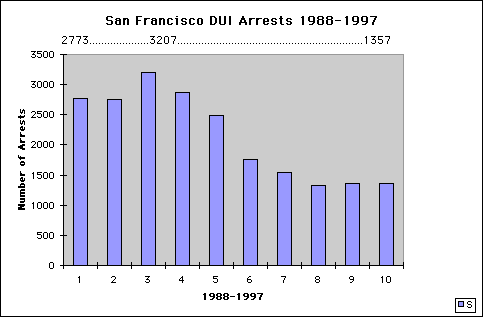
San Francisco, CA DUI Arrest Chart

DUI Arrest Chart

YEAR
1988
1989
1990
1991
1992
1993
1994
1995
1996
1997
Arrests
2773
2761
3207
2876
2480
1755
1544
1319
1357
1354

Are you in need of a California DUI Lawyer?
DUI Attorneys


California DUI Arrest

THE DUI ARREST

Detention vs Arrest

Three Levels of Police Encounter
(1) consensual contact- The Stop
(2) detention- Can be held for 24hrs without probable cause hearing
(3) arrest
(a) Miranda Rights – Custodial status- still an open issue. People v Lopez. state supreme Ct. ruled people stopped for traffic infractions are "under arrest", though Miranda custody was not in issue. Other court ruling have ruled that the field sobriety test and the chemical test are not "confessional" in nature. (b) no warrant necessary for misdemeanor ‘in the presence of an officer’, or with a complaint filed by a citizen.

Miranda Rights Field Sobriety tests are not "communications" . . .they are considered "routine booking questions" and therefore not incriminating. How does Custody relate to Miranda Rights?

What constitutes "custodial interrogation" within rule of Miranda v Arizona requiring that suspect be informed of his federal constitutional rights before custodial interrogation. California Supreme Court stated that in determining whether or not a defendant is "in custody" for purposes of the Miranda warning requirement, the "ultimate inquiry is simply whether there is a ‘formal arrest or restraint on freedom of movement’ of the degree associated with a formal arrest" .."the test, of course, is an objective one – how a reasonable person in the suspect’s position would have understood his situation."…."Would such a person feel that he has been subjected to restraints comparable to those associated with a formal arrest? If so, he was ‘in custody’ and entitled to Miranda warning.

Have you been arrested for a DUI? Contact a California DUI Attorney.

DUI Attorneys


California DUI Laws

The police officers blend into the thriving party scene, milking
drinks in the corner of a north Fresno bar.

They are undercover — a man and a woman — watching for partiers who
are obviously drunk or are downing drink after drink.

Fresno police are taking enforcement of the California DUI laws to a new level — which officers expect will bring both success and outrage. Saturday night, the traffic unit unveiled a new operation in which plainclothes police officers stake out bars and target drunk patrons. If the heavy drinkers get behind the wheel, officers in unmarked cars follow them and call in marked police cars to pull them over.

Four people were arrested during a four-hour operation at two bars in
northeast Fresno.

"It’s a new idea," traffic Capt. Andy Hall said. "It’s a new way to
address the problem of drunk driving."

Hall say it’s necessary because of a string of DUI collisions — some
of them fatal — in which drivers had come from drinking at a bar or
restaurant.

Gerardo "G" Franco, manager of The Dirty Olive, said he supports
police efforts to get drunken drivers off the road, but putting
undercover officers in bars will make his customers uneasy.

"It completely makes our patrons feel uncomfortable," Franco said.
"They have no idea who is a police officer and who is not."

Franco doesn’t believe it will hurt his business, because he said The
Dirty Olive is doing its best to ensure patrons get home safely.

Tony Brisceno, co-owner of Veni Vidi Vici in the Tower District, said
he believes bar profits will be affected.

"It’ll keep people from staying out so late, having more drinks," he
said. "They might just stay home and buy some alcohol."

Traffic detective Mark Van Wyhe said that while he expects some people
to be upset, he’s trying to make the community a safer place.

"If they’re going out there and they’re being responsible, I don’t
think it should bother them a bit," he said. "I think they should be
happy that we’re trying to prevent others from being involved in a DUI
collision.

"We’re not trying to discourage them from going out and having a good
time. We just want them to be smart about it, whether that’s getting a
designated driver or a taxicab."

Van Wyhe and a crew of officers conducted its first-ever bar
surveillance operation on Feb. 10 but didn’t go public with the program
until the second go-round Saturday. In the first one, six people were
cited on DUI charges after undercover officers were inside El Molino Rojo
and El Dorado nightclubs.

Police will target bars in areas that have the most DUI
collisions.

Saturday night, Van Wyhe focuses on The Dirty Olive and TGIFriday’s.
The operation gets started before two undercover officers are positioned
inside The Dirty Olive, off Friant Road.

As unmarked police cars pull into the parking lot about 10:30 p.m., an
officer notices a man stumbling to his car with a woman.

Van Wyhe follows the man, later identified as Timothy Lancaster, as he
drives a newer-model BMW left onto Fort Washington Avenue. A motorcycle
officer catches up and pulls the car over as it turns onto Champlain
Avenue.

Lancaster, 41, tells police he had been dining with his girlfriend at
Sakanaya restaurant, next to The Dirty Olive. It’s a special occasion:
They just got engaged.

Lancaster tells officer Jason Ciavaglia he had two beers at the
restaurant. But he is cited with DUI after blowing a 0.08 in a
Breathalyzer test, Ciavaglia said.

Back at The Dirty Olive, one of Fresno’s most popular bars, the
undercover officers set up camp in a corner after getting some drinks at
the bar. Van Wyhe and Sgt. Bruce Owen are keeping a low profile outside
in a white sport utility vehicle with tinted windows.

The bar is packed. The officers decide to move around to observe the
clientele.

An hour passes. As the bar nears its closing time of midnight, patrons
pour into the parking lot. The officers are people-watching from a table
near the door, then move outside and linger.

The next half-hour is the busiest of the night. The plainclothes
officers pound Van Wyhe with phone calls, describing patrons who appear
visibly drunk as they walk out.

Van Wyhe and Owen, in turn, keep tabs on the cars and their direction
of travel, while dispatching patrol units to go after them.

"It’s like someone opened the floodgates," Van Wyhe said. "Everybody
was just running crazy in the parking lot being blatantly drunk."

It results in a spate of traffic stops within a half-mile of the bar.
On nearby Friant Road, three motorists have been pulled over in a
300-yard stretch.

One of them, Thomas Miller Jr., 33, was pursued after Owen sees him
and a passenger urinating on the tires of Miller’s Range Rover. During
the traffic stop, Miller tells police he had four or five beers at The
Dirty Olive. He refuses to take a Breathalyzer test, so officers take him
to have his blood drawn. He is cited with DUI.

Miller’s brother, 31-year-old Tim Miller, stands on the roadside,
sorting out the details of his brother’s arrest with police. He is told
about the new operation.

"That’s dirty," Miller said. "I’m kind of torn with that. I think it’s
good to get drunk drivers off the street. But to go in and sit in bars
and watch people, I think it’s underhanded. â? That’s one
more step the government’s taking, and I don’t like it."

Up the road, 24-year-old Nicole Gonzalez of Clovis is put in the back
of a patrol car. She tells an officer, Mark Bradford, that she works at
The Dirty Olive but is off that night. She told officers she had two
shooters there before leaving. But she, too, refuses to take a
Breathalyzer test and calls her lawyer. She is cited with DUI and taken
away for a blood sample.

After her blood is taken, Gonzalez runs into Bradford. "See you in
court," she says.

"I’ll be there," he replies.

About 1 a.m., the police head to the next bar. When Van Wyhe rolls
into the parking lot of TGIFriday’s, an officer in a marked police car
has mistakenly parked there. Van Wyhe asks him to go somewhere less
visible.

The plainclothes officers make their way into the bar. It’s not nearly
as crowded as The Dirty Olive, but at 1:23 a.m., the female officer calls
Van Wyhe to say there are several people who are obviously drunk.

Minutes later, two young women leaving the bar openly talk about
whether they’re sober enough to drive. Van Wyhe calls for motorcycle
officer to follow one of the women, who is driving a white Lexus.

On Herndon Avenue, the officer pulls over 21-year-old Jacqueline
Garcia. She tells an officer she has had two cocktails, and says she is a
recovering alcoholic, Ciavaglia said.

During field sobriety tests, Garcia can’t walk straight or say the
alphabet, the officer said. She is cited with DUI.

TGIFriday’s doesn’t yield any more action. Van Wyhe calls off the
operation at 2:15. He says he is pleased with the results, but next time
wants more uniformed officers to keep up with the flow of patrons.
Meanwhile, he’s expecting a strong reaction from the community.

"There may be people who are offended by officers conducting
surveillance in bars," Van Wyhe said, "but the harsh reality of it is
that people continue to drink and drive, and we’re going to take whatever
measures necessary to stop this senseless crime and save lives."

Source: http://www.officer.com/

Are you in need of DUI Lawyers in California?

DUI Attorneys


California DUI Statistics

Author: American Beverage Institute Published on Sep 14, 2006,
07:33

In light of the fact that drunk driving deaths in California jumped by
5.5% in 2005, the American Beverage Institute (ABI) is urging state law
enforcement officials to abandon their ineffective roadblock
campaigns.

According to the newly released National Highway Traffic Safety
Administration (NHTSA) data on 2005 alcohol-related fatalities, there
were 76 more people killed in drunk driving fatalities in California last
year than in 2004.

"It is time for California to reevaluate how it is addressing its
drunk driving problem," said ABI Executive Director John Doyle. "Rather
than rely on roadblocks, as California does, the state should invest more
of their law enforcement resources in roving police patrols."

According to a landmark NHTSA study, "the number of DWI arrests made
by the roving patrol program was nearly three times the average number of
DWIs made by the checkpoint programs."

The newly released NHTSA data also reinforce the superiority of roving
patrols over roadblocks:

  • The 11 states that do not operate roadblocks experienced a
    collective drop of 91 fewer alcohol-related fatalities in 2005 compared
    to 2004;
  • The 39 states (plus the District of Columbia) that operate
    roadblocks saw a collective increase in alcohol-related deaths;
    and
  • If non-roadblock states are removed from the equation, there would
    have been a net increase in nationwide alcohol-related fatalities last
    year.

"It is incumbent upon the states to use the most effective measures
available, and clearly the data show that roving patrols are much more
effective than roadblocks at getting drunk drivers off the road," said
Doyle.

The American Beverage Institute is an association of restaurants
committed to the responsible serving of adult beverages. To learn more
visit: http://www.americanbeverageinstitute.com/.

© Copyright 2006 YubaNet.com

Source: http://www.YubaNet.com

Are you in need of California DUI Lawyers?

DUI Attorneys


Los Angeles DUI

LOS ANGELES – A Swedish businessman who crashed a rare, $1.5-million
Ferrari in Malibu pleaded no contest Thursday to drunk driving.

Next week, Bo Stefan Eriksson, 44, will be in court to face charges of
felony grand theft and embezzlement.

Los Angeles County Superior Court Judge Patricia M. Schnegg will
sentence Eriksson for the drunk driving offense at the conclusion of his
trial. First time DUI offenders are usually sentenced to probation and
Alcoholics Anonymous meetings, said Jane Robison, a spokeswoman for the
district attorneys’ office.

Eriksson, 44, is a former executive of the now-bankrupt video game
company Gizmondo Europe. Prosecutors contend he was drunk on Feb. 21 when
he plowed a red Enzo Ferrari into a utility pole on Pacific Coast Highway
at 162 mph.

Authorities originally accused him of stealing the rare vehicle from a
British bank, but dropped those charges this week. He still is charged
with stealing two other cars, a black Enzo and a Mercedes-Benz SLR
McLaren.

Authorities contend Eriksson defrauded British banks who loaned him
money to buy the fancy cars. Once he had the cars, Eriksson would take
them to the United States and halt payments on the loans, authorities
said.

On Monday, Eriksson turned down a plea offer which required him to
plead guilty to stealing the Mercedes and the black Enzo. He agreed to
plead no contest to misdemeanor drunken driving because "it’s always
better to fess up what you’ve done," said his attorney, James
Parkman.

"We want to fight the battle where the battle is," Parkman said. "It
makes no sense to chase windmills and waste the jury’s time and the
court’s time."

Eriksson could face up to 11 years in prison if convicted of the
felony charges.

Eriksson, who has a Swedish criminal record for extortion, assault and
other crimes, will be tried separately on another felony charge of being
a felon in possession of a firearm – a .357-Magnum handgun found in his
Bel-Air home during an April search.

See pictures of crash: http://www.wreckedexotics.com/special/enzo/

Associated Press Source: http://www.mercurynews.com/

DUI Attorneys


Report Critical of How DMV Sells Information

SACRAMENTO — DMV Information Sold Illegally, State Audit Finds
Agency Also Reaped Profits by Overcharging Clients

Thursday, July 3, 1997 · Page A19 ©1997 San
Francisco Chronicle

Greg Lucas, Chronicle Sacramento Bureau

Sacramento

The Department of Motor Vehicles illegally sold the confidential
addresses of private citizens, according to a new state audit that also
found the agency overcharged nearly $100 million to companies that made
legitimate requests for driver and vehicle records.

The state audit, conducted at the request of the Legislature, found
that over the past six years the DMV has dramatically overstated its
costs for selling information to private companies while giving the same
information to government agencies for free.

While the excessive fees were paid primarily by banks, insurance
companies and lawyers, they are likely to be reflected in the rates those
firms charge customers.

Perhaps the most startling revelation in the 35-page audit was that
the DMV sold Safeway Inc. a list of 1,000 confidential addresses of
drivers parked in the lots of two rival supermarkets. During the $5,000
transaction, the DMV failed to obtain the required written promise from
Safeway not to use the information for direct marketing.

“The department did not comply with the law,” the audit said of the
Safeway transaction. “(It) may have jeopardized the privacy of
individuals who were the subjects of the information and exposed them to
the risk of unwanted or unsolicited contact.”

Debra Lambert, a spokeswoman for Safeway, said the company used the
information for marketing research. “It’s a statistical type of analysis.
What it does is help define trading areas around our stores and around
competitor stores. It’s a data-gathering exercise.

“It’s only addresses,” she added. “We keep the data to ourselves. It
is never divulged outside of the company.”

The DMV said the October 1994 Safeway transaction was one
“deficiency” in the 50 to 70 requests for information studied by state
auditors. Auditors, however, said they examined only a fraction of the
“tens of thousands” of transactions conducted by the department over the
past six years.

Under a 1990 law, residential addresses maintained by the DMV are
confidential unless the requester proves the information is needed for a
legitimate business reason. Even then, no names can be revealed, and
purchasers must promise not to use it for direct marketing.

An “alert auditor” stumbled across the Safeway transaction while
going over the DMV’s books to see whether the prices charged private
companies for driver and vehicle information reflected the department’s
costs of providing the information, said State Auditor Kurt Sjoberg.

Overall, the audit found that the department had “significantly
overestimated” its costs — creating a profit of $99 million over the
past six years at the expense of insurance companies, lawyers, banks,
credit unions and trucking firms that buy information from the DMV.

And, the audit said, since the costs were calculated incorrectly in
the first place and have not been corrected in six years, the department
cannot “assure the fairness of its fees nor can it properly identify or
manage product profitability.”

Said Sjoberg in an interview:

“We were asked to see whether fees charged for information products
relate to costs of providing those products. The DMV has turned it into a
different discussion. They’re saying they should be able to charge
whatever the market will bear for a product the state has a monopoly
on.”

Profit is legal and necessary, the DMV said in its response to the
audit’s findings. Revenue is needed to defray the costs of providing
records on vehicle ownership, driver status, traffic accidents and
convictions to law enforcement and other government agencies for
free.

“Reducing the fees and therefore the profits currently charged could
shift the costs from fee paying customers, such as insurance companies,
to the general public through increased fees for driver licenses and
vehicle registrations,” the department concluded in its four-page
response to the audit.

Governor Pete Wilson and the DMV are trying to jack up those fees
anyway to fill a $41 million deficit in the sprawling agency’s
budget.

In his May revised budget plan, Wilson backs increasing vehicle
registration fees by $1 to $30 a year, increasing title transfer fees
from $10 to $15 and charging people whose licenses are suspended or
revoked $55 instead of $15 to have them reinstated.

Every owner of a vehicle — there are 27 million registered in the
state — will feel the $1 hit in registration fees.

The state estimates there are 3.8 million title transfers a year and
400,000 Californians requesting their licenses be reinstated.

The fee increases are needed, the GOP governor argues, because the DMV
is $41 million in the red.

Although the audit found that the prices some customers were paying
far exceeded the department’s costs, other charges for information were
dramatically less than actual costs. In one case, the audit found that
the department charged $70 for a statistical report costing $1,000.

DUI Attorneys